Originally posted by RIDER
Interview by Cyreen Abichou and Mehmet Oztan
This interview was conducted in August 2026. You can find more information about Dr. Elwardany's work on his profile page.
Background & Research Journey
Can you tell us about what led you to civil and pavement engineering?
What originally drew me to civil engineering was its direct and immediate connection to society. The infrastructure we design, build, and maintain touches almost every single aspect of our daily lives.
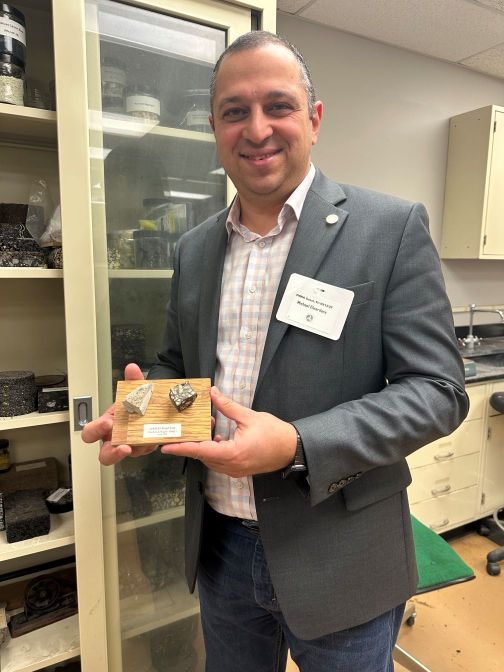
My deep interest in pavements stems from my passion for materials science. I am fascinated by viscoelastic materials, polymers, and composites. When you look at a road or an airfield, it might seem like a simple flat surface, but underneath, it is a highly engineered composite in a multi-layered structural system. It must withstand millions of heavy vehicles while enduring decades of environmental exposure and chemical changes. Studying the chemo-mechanics of these materials, how chemical changes affect physical behavior, and finding ways to make them more durable is what motivates my work every day at the PRISM (Pavement Resilience and Innovative Sustainable Materials) Lab.
How did your experience in industry influence your academic research?
My time in industry was incredibly foundational. Serving as Program Manager for Paving Asphalts at the Western Research Institute and later as Laboratory Manager & Lead Research Engineer at the Federal Highway Administration (FHWA) Turner-Fairbank Highway Research Center gave me a front-row seat to the real-world challenges facing our national infrastructure. It showed me that a gap can often exist between pure laboratory work and practical implementation.
Because of that, my research is highly application-driven. We bridge the gap between microscopic binder chemistry, such as studying asphaltenes, oxidative aging, polymer modifications, and pavement performance. In our PRISM Lab, we apply cutting-edge mechanical theories like Viscoelastic Continuum Damage (VECD) to model fatigue cracking and plasticity theories to address rutting. By aligning our fundamental science with Balanced Mix Design (BMD) principles, we deliver solutions that practitioners and state departments of transportation can directly use.
What motivated your transition from industry into academia?
The primary driving force was my passion for student mentorship and the opportunity to help shape the next generation of engineers. While I loved solving technical challenges in industry, academia allows me to do that while simultaneously building characters and careers.
In the PRISM Lab, student mentorship is at the core of our mission. I am deeply committed to training undergraduate students on essential research skills and helping them develop their "researcher persona" and critical thinking. For our graduate students (MS and PhD), my goal is to guide them in developing as independent, self-driven researchers who can confidently lead projects, publish high-impact papers, and present on the national stage. Seeing a student transition from a learner in a classroom to an innovator in the lab is the most rewarding part of my career.
What are some real-world challenges in pavement engineering that your research adresses?
Our transportation infrastructure is facing stressors from both escalating traffic demands and extreme weather. A major focus of the PRISM Lab is paving a resilient path forward. We specifically study pavement resilience in coastal areas, looking at how flooding, hurricanes, and severe moisture damage impact the longevity of our roads. We also work on airfield pavement resilience to ensure our critical aviation hubs remain fully operational under extreme conditions.
To address these challenges, we research long-term oxidative aging modeling, moisture damage behavior, and material durability. We want to know exactly how materials degrade over 10 or 20 years in the field. By understanding these mechanisms, we can formulate highly durable pavement structures that are simultaneously durable, resilient, and economical.
Your research focuses on matters such as material durability, pavement performance and design, and machine learning applications in pavement engineering—how do your findings in these areas improve transportation infrastructure in practice?
We are working hard to make pavement engineering more predictive and science based. Historically, pavement design has relied on empirical models. Our research is shifting the paradigm toward performance-based engineering.
By combining multi-scale characterization of composite materials with advanced data-driven approaches, we are creating powerful tools for the field. For instance, our lab leverages machine learning and deep learning, such as Physics-Informed Neural Networks (PINNs), to predict pavement cracking and performance. We also do not use machine learning models as a black box, but we spend time to understand our data and interpretable approaches to make sure our models follow the fundamentals of science and engineering. This allows state agencies to make highly efficient, proactive investments in infrastructure, selecting the optimal durable materials and pavement designs.
What is cooking in your research lab these days? Can you give us an overview of the newest achievements and success stories?
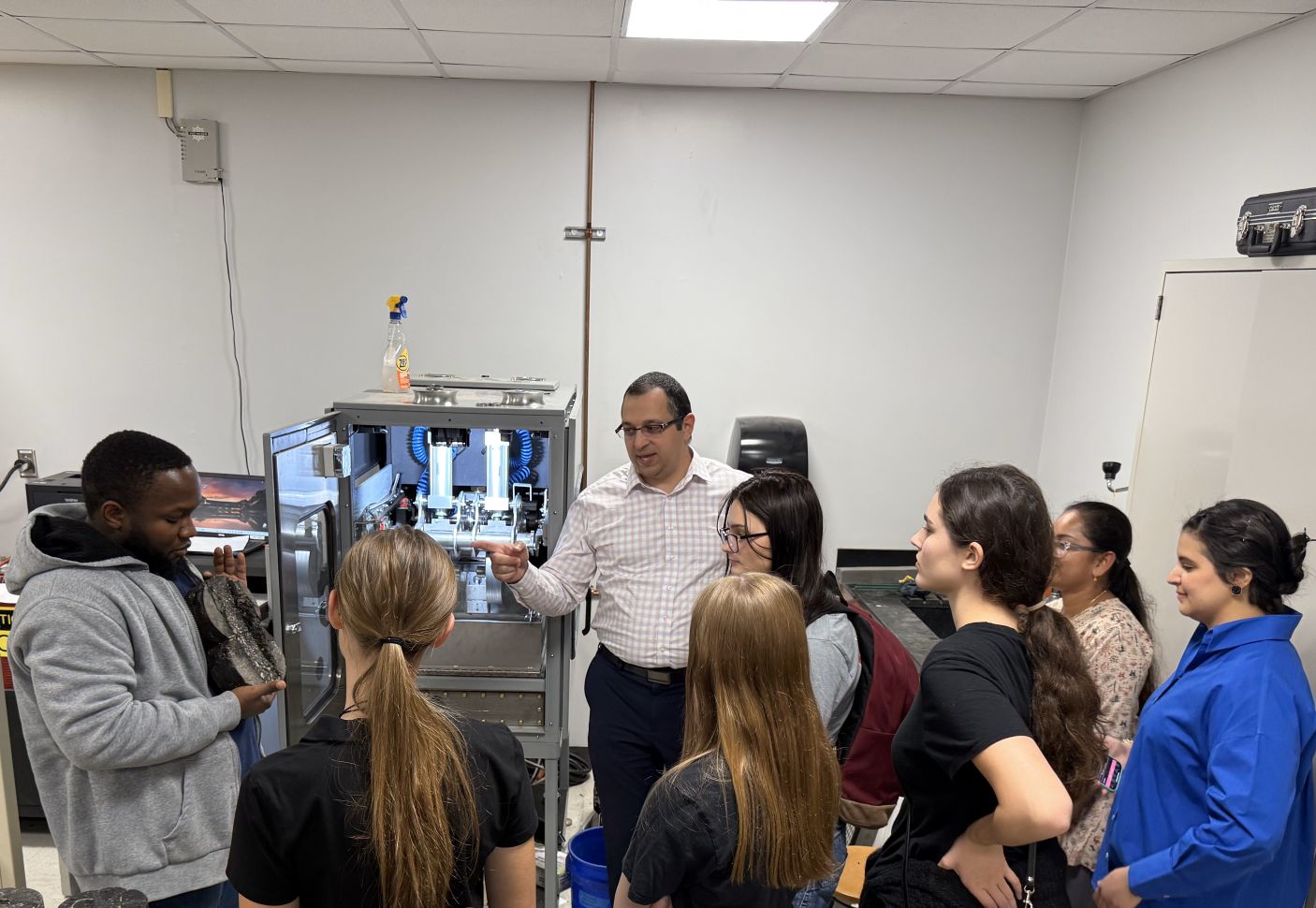
The PRISM Lab is absolutely thriving right now! We are bridging advanced polymer chemistry, state-of-the-art mechanical testing, and data-driven modeling to solve critical transportation challenges.
Here is a snapshot of our latest highlights:
- Commercializing Innovation: We recently wrapped up our US DOT SBIR Phase I & II projects ($1.25M total award) to accelerate pavement performance testing using AMPT equipment and developed a patent-pending collet-chuck clamping system for solid materials. This breakthrough work inspired us to participate in the NSF I-Corps Regional Program to transition our lab discoveries into real-world market solutions.
- BMD & Thermal Cracking Standards: Through the national NCHRP 09-71 project ($650k total award), we are collaborating with UMass Dartmouth, Rutgers, the Phil Blankenship lab, and leading consultants to build a standardized national framework for asphalt mixtures. This is supported by our newly launched National Academies of Sciences NCHRP IDEA project ($140k award) to develop the IDEAL-Low Temperature Cracking (IDEAL-LT) test right here at FSU to protect roads in cold regions. We are also kicking off a new initiative with industry and academic experts to develop guidelines for mitigating silo storage impacts on BMD mixtures.
- Sustainable & Next-Gen Materials: We recently concluded a $240k Florida DOT (FDOT) grant evaluating Reclaimed Asphalt Pavement (RAP) in mixtures with high-polymer binders. As a consultant, I also completed a national level study on binder, chemo-mechanics, and rheology-mechanics based specification under the NCHRP 09-60 with the Western Research Institute and the project team. Furthermore, we are collaborating with BASF Corporation and the National High Magnetic Field Laboratory (MagLab) to investigate the fundamental chemical reactivity and compatibility of B2LAST, an innovative isocyanate-based liquid modifier, with base binders from various crude sources.
What I am most proud of, however, is our student-led success. Our undergraduate and graduate researchers are the engines of the PRISM Lab. They are actively publishing in top journals like Construction and Building Materials and the Transportation Research Record. They are presenting their research at national forums like the Transportation Research Board (TRB) Annual Meeting in Washington, D.C., and winning prestigious national honors. We have built a vibrant environment where students get hands-on experience with advanced, state-of-the-art laboratory technologies while solving nationally relevant problems.
Community Service & Leadership
Most recently, you took the lead in co-creating the Future Leaders in Asphalt (FLA) Program with your industry partner, ATS Consulting, and the program will be housed in our college. How does your involvement with this program complement your research and your broader commitment to the professional community?
The Future Leaders in Asphalt (FLA) program is an exciting extension of our work in the PRISM Lab. I firmly believe that academic research should never exist in a silo. If we want to truly revolutionize our transportation infrastructure, we must build a bridge between our classrooms, our labs, and the industry.
Through the FLA program, which is proudly housed here at the FAMU-FSU College of Engineering, we are collaborating with Tanya Nash, a renowned industry consultant and the Director of Engineering at Asphalt Testing Solutions & Engineering, to create a unique platform that connects emerging industry leaders directly with industry executives and mentors. This program complements our research by preparing future industry leaders with the critical soft skills, professional leadership, and industry context they need to succeed.
All these collective projects and community service efforts ensure that when our students graduate, they are not just outstanding technical researchers, but are ready to step into roles as collaborative, forward-thinking leaders who will drive innovation across the entire transportation sector.